
NYX Tamère
Interview by Nawaal Bhuiyan
Photography by Alice Larrivée
Drag King, Queen, and Everything in Between – An Interview with Nyx Tamère
Tell us who you are and what you do!
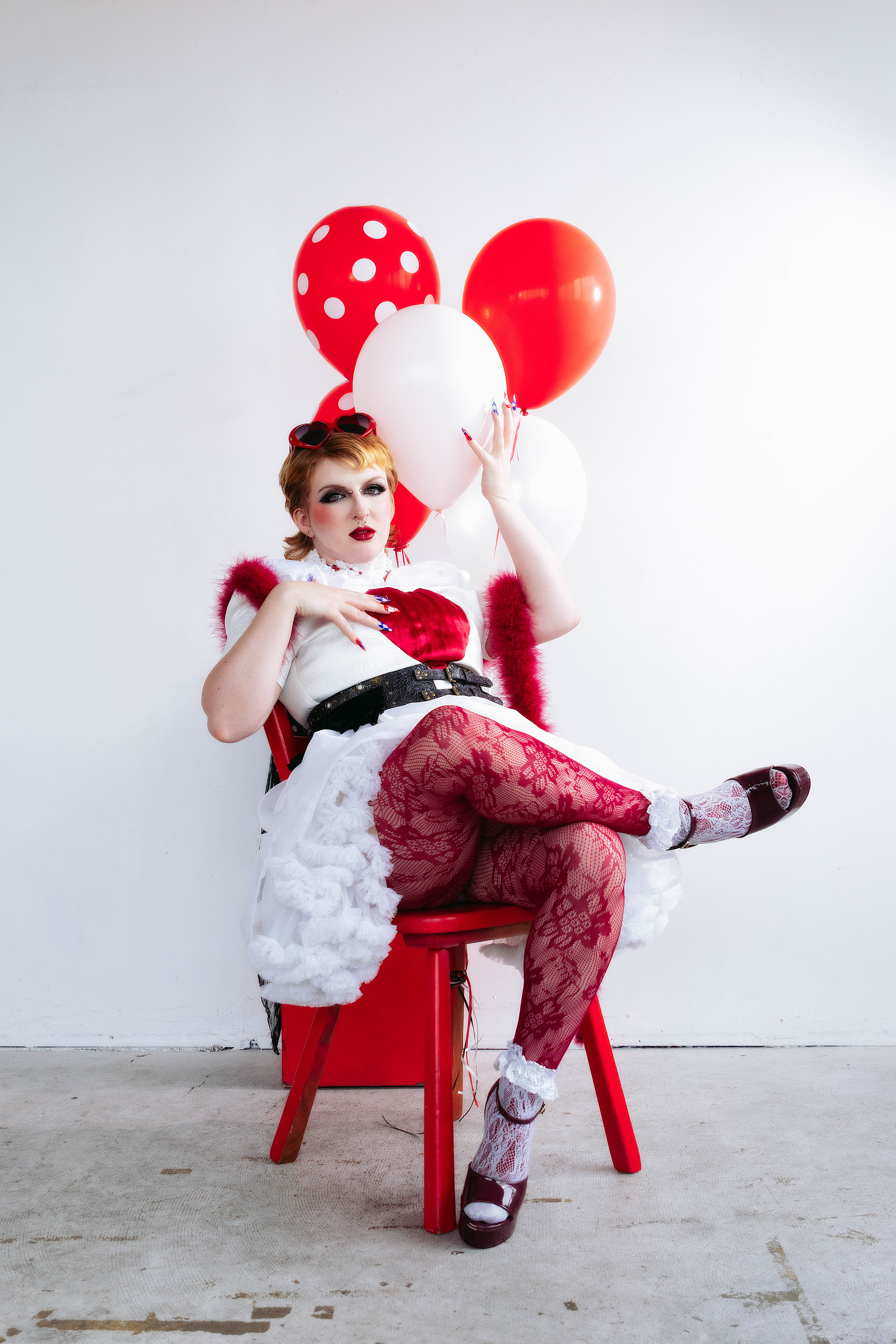
My name is Nyx Tamère. I'm a drag queen who's been performing for about two years now in the Montréal circuit. I've been taking a bit of a break from performing this past year just because I'm also a full-time student, and I work full-time, and drag’s expensive. But this past year has been really about honing my skills, trying to get together some acts that I can put out into the world and feel really proud of. A lot of my drag comes from kind of a horror background. I'm a filmmaker, animator, and stop motion puppeteer, so there’s always this uncanny valley, puppet-or-doll aesthetic—though I veer off into other nonsense, always with a purpose.
What are three to five songs in your “Getting Ready for Drag” playlist?
Well, there's a lot of Gaga, and a lot of the playlist is songs that I've performed before. It gets me in the mood like, okay, I'm gonna be on stage, so I need to know the words, I need to know what I'm doing, and I'm planning choreography in my head as I’m putting on makeup. Honestly it's a lot of musical theatre. If I'm getting ready at a show, I don't take the aux—nobody can know I'm an ex-theatre kid. I've been getting into a lot of PinkPantheress recently; she's like nightcore revival. I need something to get me going, something to raise my energy so I can shake off work and step onstage.
How did you get your start in drag in Montreal, and what drew you to perform in the first place?
I've been really into drag for a long time. I was lucky to have liberal parents who brought me to pride parades when I was a kid. According to my mom, a drag queen in Providence wrapped a boa around baby-me’s neck and that made me a drag queen and a lesbian in one go. I did theatre, cosplay, and cons, so I had a makeup background. About two years ago, Yikes Macaroni hosted an open mic for anyone who wanted to try drag. I showed up with ratty hair, concealer lips, and did this awful country act—and it was so fun. I realized if I put effort in, I could make this work. From there I took any show that would have me, and lately I've been leaning into burlesque because, at least in Montreal, burlesque and drag are sisters sharing the same spaces. If you’re dedicated and work your ass off, you can get booked.
Tell us a little bit about your drag persona. Do you see them as being an extension of yourself or as a very separate character that you've crafted over the years?
I'd say she’s kind of a version of myself, but she’s still a fetus. I haven’t had a ton of opportunities to craft Nyx, which is why I’ve stepped back to figure out my identity. At first Nyx was a possessed creepy doll inspired by Annabelle, but my acts have grown beyond that. In real life, I'm a butch lesbian on testosterone—I lived as a trans man for years before reclaiming “butch” and blurring lines. Drag lets me explore femininity in a comfortable way. I wasn’t feminine as a kid; I had responsibilities. Yet I loved pageants and Toddlers & Tiaras. The circus theme of this issue is perfect—I’m obsessed with 1920s vaudeville creepiness. Drag’s freak show angle feels liberating; a lot of us feel like freaks, so why not make the most of it?
Do you think that Nyx right now has a very distinct look, and has her look changed since you've started doing drag?
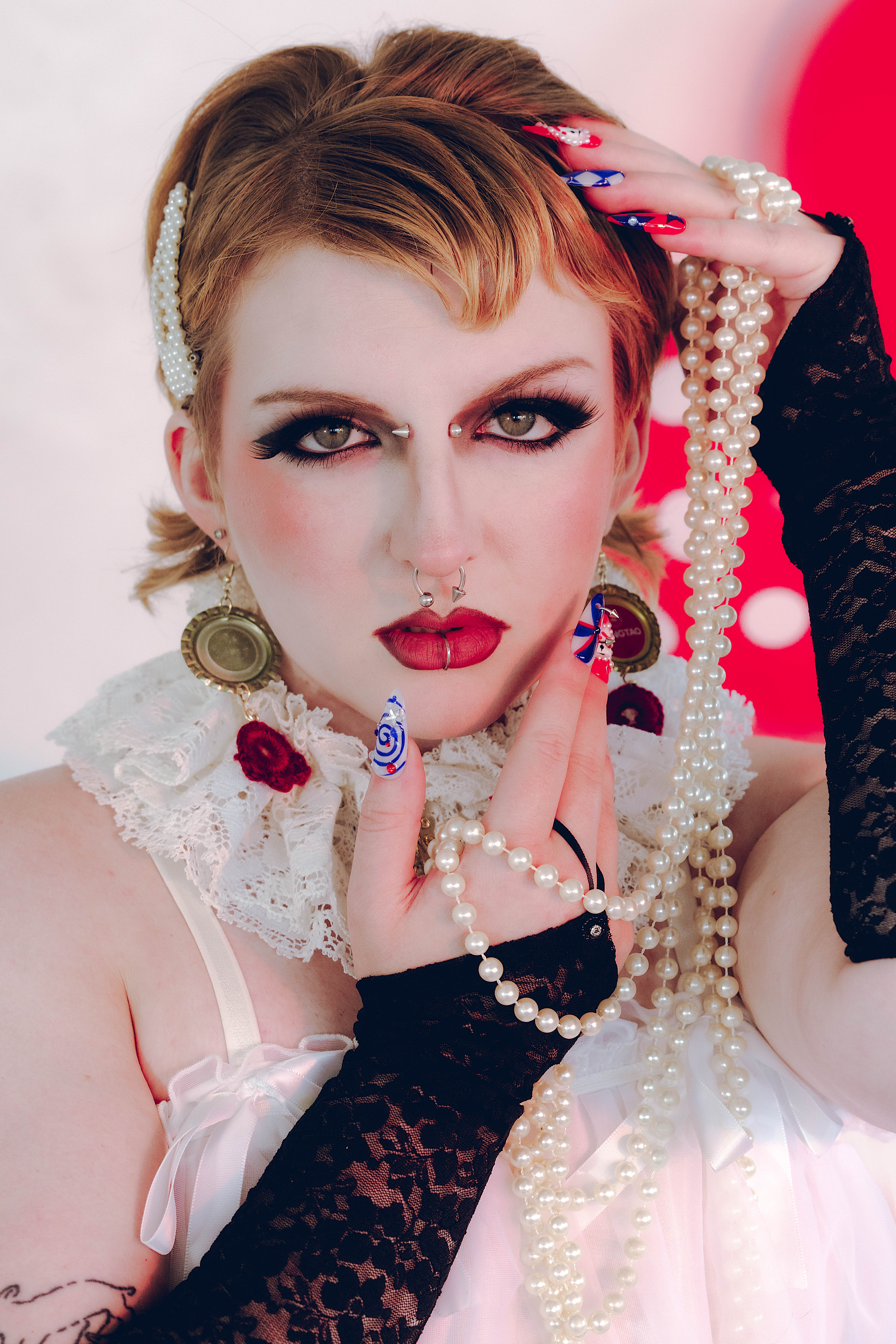
Absolutely. I mean, I started with Republican face, so there was nowhere to go but up. Pinterest has been a lifesaver, and Montreal’s alternative drag scene really blurs lines between drag and other performance, letting my look evolve quickly. I tried to look like Farrah Moan as a kid, but it wasn’t me. My look now is white base, tiny lips, big buggy eyes—unsettling but still cute and a little sexy. There’s something sexy about fear. I love combining creepiness with glamour; there’s a reason people swoon over horror movie characters.
I wanted to ask you about drag jargon. Do you have any favourites?
Honestly, I don't feel like I know enough traditional drag queens—I know drag things and creatures and kings. There’s still division between queens and everyone else. It’s like a middle school dance with boys on one side and girls on the other. Jargon-wise, “slay” is classic, but I also love calling makeup “painting.” It’s more than makeup; you’re laying a base and building volume, sometimes using Sharpies, cement, cornstarch, even deodorant sticks as primer. Regional terms are great, too—New York performers talk differently than those in Boston or Ottawa.
Can you tell us a little bit about your first and/or most memorable performance? What made it so special?
My most memorable was my first big girl show: Fatal, a burlesque show specifically for trans performers at Cafe Cleopatra. I like to be sexy—it boosts my confidence and connects me to my body. I’ve been taking dance classes with Ell Eros, a powerhouse performer who teaches strip-club moves and emphasizes honoring their origins. Drag often borrows from sex work and burlesque without giving credit, but people like Ell have welcomed me in. Fatal taught me that if I want to be proud of an act, I need to work it until it’s exactly what I want. My “Cuntmunism Act” to “When I Rule the World” ends with me pulling a cardboard Communist Manifesto labeled “Kunt Marx.” Rosie Bourgeoisie, who runs the show, complimented me and that solidified my desire to make this a career.
What place do you think drag has in the art or nightlife scene in Montreal?
Drag is a huge part of Montreal nightlife; the city wouldn’t be the same without us. Between strippers, burlesque performers, and drag artists, there’s a trifecta operating in the same spaces. Strippers come to drag shows to perform for queer audiences who respect them. Variety shows that mix comedy, burlesque, drag—blurred lines make everything better because it’s all performance art. Drag is a foundation of Montreal nightlife.
Since you talked a little bit about Ell and some barriers that they face performing, have you faced any barriers when it came to getting booked or what you were allowed to perform?
Absolutely. In traditional drag spaces it’s rough being a trans drag queen because there’s still an idea that people assigned female at birth shouldn’t be queens. Gottmik is a huge inspiration—he proved trans men belong on drag stages. Older generations faced extreme danger just for putting on wigs, so I understand their protectiveness, but femininity isn’t experienced the same way by everyone. Drag is exaggerated femininity; even queens like Sasha Colby amplify themselves, so it’s all drag. On the flip side, newer performers sometimes police everything to “outwoke” each other. It creates unnecessary division and becomes conservative in its own way. Why are we pushing the pendulum so far that it comes back around?
Are there any pervasive stereotypes about drag that you want to address?
The obvious one is conservatives thinking drag is dangerous or inherently sexual. Drag is a queer art, so sexuality shows up because ours has been policed, but not everyone performs that way. There’s plenty of PG drag. I got christened by a drag queen as a baby and turned out fine. Drag is just such a broad term; we’re expressing ourselves and sharing art. As climate-terrorist RuPaul says, “You’re born naked and the rest is drag.”
What do you think drag can teach those unfamiliar with the niche?
Drag teaches you to let go of ego. Your first time on stage with busted paint and a shiny synthetic wig? You will look bad—and that’s a canon event. It humbles you. You can’t fake confidence without doing the work. Reading each other is constructive criticism: I’ll tell you you look busted so that next time, you don’t. Even the most accomplished queens can look foolish; that vulnerability is how you grow.
What does drag mean to you? How do you perceive its radical potential?
I view drag as a satirization of genders. Whether you’re a king, queen, or in-between, you’re playing with gender. On stage I’m not a woman; I’m a drag queen presenting femininity in a twisted, DIY way that makes me feel sexy. Drag makes gender and luxury accessible. Ballroom takes high fashion and recreates it to claim space. Maybe you can’t afford Paris Fashion Week, but you can drape thrifted fabric and feel like a supermodel. That reclamation is powerful.
What are your current goals as a performer?
Goal number one: get booked at The Wiggle Room. Let me in, coach! I’ve applied and been rejected because I'm still new and that venue is high-end—you’re paying $30 for a curated show. My plan is to develop capsule performances, upgrade some pieces, and rehearse until they’re tight so I can pitch them to Wiggle Room producers and others. I also need more connections. I don’t have a drag family yet because I haven’t figured out how to find one. I want to carve out a me-shaped hole in this scene.
What does the future of drag look like in your wildest dreams?
In my wildest dreams? Everyone holding hands, spinning in a circle, and kissing on the lips. Really, I want less division. More spaces for queens, kings, alternative drag—everyone. More spaces specifically for genderqueer and trans performers, because our experience is different. RuPaul once implied hormones or surgery were “cheating,” which is ridiculous. The pioneers of drag didn’t have access to those things; we’re just continuing the work. I don’t need drag to be fully mainstream, but visibility helps people fear it less. I just hope the grassroots, rough-around-the-edges foundation stays alive so young performers aren’t pressured to show up in $3,000 gowns.
Finally, where can we find you? Please plug yourself.
You can find me @nyxtameredrag on Instagram. I’m trying to post more looks, and I’m open for bookings—weddings, divorces, funerals, bar mitzvahs, baby showers. Keep an eye out for a possible Twilight show around October. I’m around, lurking the city, and I will be in your house.